Trump Greenland Arctic Defense Command Shift | Explained
Source: Lastmagazinepro.com
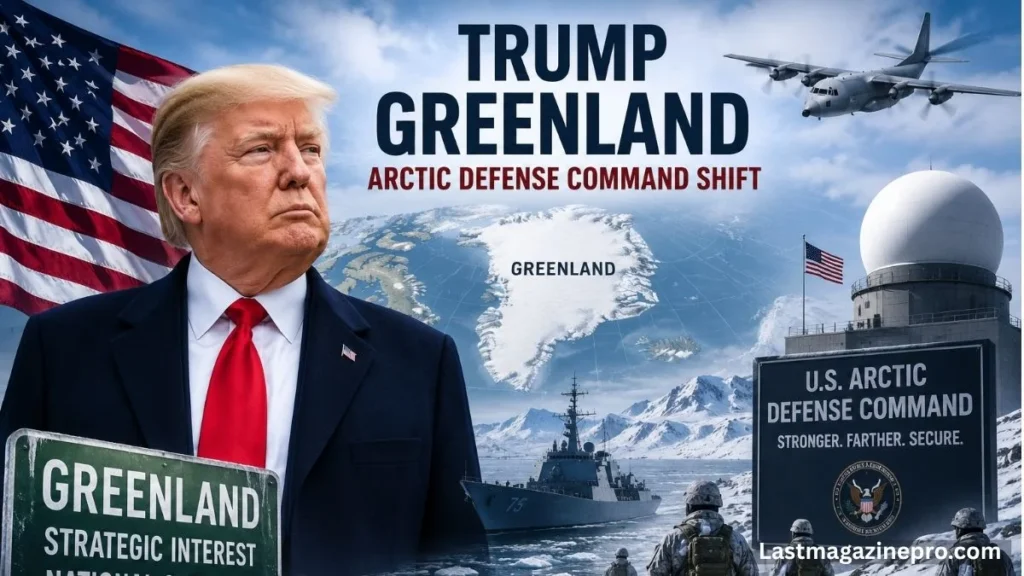
Trump Greenland Arctic Defense Command Shift? On June 17, 2025, the Pentagon shifted Greenland from U.S. European Command’s area of responsibility to U.S. Northern Command’s, a change ordered by President Trump to the Unified Command Plan. Officials frame it as a homeland-defense realignment, not an annexation move.
In June 2025, the Pentagon confirmed a change rumored for months: oversight of Greenland would move from EUCOM to NORTHCOM. Chief Pentagon spokesman Sean Parnell said the move would “strengthen the Joint Force’s ability to defend the U.S. homeland, contributing to a more robust defense of the western hemisphere and deepening relationships with Arctic allies and partners.” By law, the Department of Defense reviews the Unified Command Plan every two years, and precedent exists: the Pentagon moved Israel from EUCOM into U.S. Central Command back in 2021.
The Arctic has become one of the fastest-growing arenas of great-power competition, with melting sea ice opening new shipping lanes and Russia and China expanding polar ambitions. Greenland’s location and its hosting of Pituffik Space Base, formerly Thule Air Base, give it outsized strategic weight relative to its small population.
Analysts flag diplomatic risk. Former Pentagon Arctic official Iris Ferguson warned the shift risks alienating European allies and that Denmark should not be “sidelined”. Notably, Denmark itself remains under EUCOM even as its Arctic territory moves to NORTHCOM — a split some see as provocative.
This command shift touches homeland missile warning, NATO cohesion, and U.S.-Denmark relations at once. It’s largely bureaucratic and symbolic rather than a sovereignty change, but ripples into diplomacy and the broader U.S.-China-Russia contest for Arctic influence. This article explains what changed, why, and what allies and analysts are saying.
What Is the Trump Greenland Arctic Defense Command Shift?
1. The Pentagon’s Command Reorganization
Every two years, Congress requires the Department of Defense to review the Unified Command Plan (UCP), the document that assigns geographic areas of responsibility to each of the Pentagon’s combatant commands. During the Trump administration’s 2025 review, officials considered several structural changes, including proposals to merge NORTHCOM with U.S. Southern Command and to combine EUCOM with U.S. Africa Command. Those broader consolidation ideas drew pushback from congressional defense leaders and were not included in the final announcement. The Defense Department completed its congressionally mandated Unified Command Plan review and announced its decision to transfer oversight of Greenland from EUCOM’s area of responsibility to NORTHCOM.
2. Moving Greenland from EUCOM to NORTHCOM
U.S. Northern Command now oversees American military troops and operations in Greenland, a responsibility that had long belonged to U.S. European Command, according to a Pentagon announcement. Denmark itself and the semi-autonomous Faroe Islands remain under EUCOM, meaning the change applies specifically to the island of Greenland rather than to the Kingdom of Denmark as a whole. This creates a split where the Pentagon’s oversight of Greenland shifts toward alignment with the United States while Copenhagen stays under the European command structure.
3. Why the Change Happened?
President Trump ordered the change as part of the biennial Unified Command Plan review, and the Pentagon’s chief spokesman said the move reflects the administration’s long-stated interest in the island’s role in national security and Arctic defense. Pentagon leadership framed the decision in operational terms. Chief Pentagon spokesman Sean Parnell said the change would strengthen the joint force’s ability to defend the U.S. homeland, support a more robust defense of the Western Hemisphere, and deepen relationships with Arctic allies and partners.
Understanding U.S. Military Combatant Commands
1. What Is U.S. European Command (EUCOM)?
EUCOM is one of the Pentagon’s geographic combatant commands, responsible for planning and directing U.S. military activity across most of Europe. It has historically overseen the defense relationship with NATO allies, including Denmark, and previously included Greenland within its area of responsibility due to Greenland’s status as Danish territory.
2. What Is U.S. Northern Command (NORTHCOM)?
NORTHCOM is charged with homeland defense and security cooperation across North America. It works closely with U.S. Northern Aerospace Defense Command (NORAD), the binational U.S.-Canada organization responsible for aerospace warning and control. NORTHCOM is led by Air Force Gen. Gregory M. Guillot, who also commands NORAD, and Greenland’s reassignment places the territory under his oversight.
2. How Areas of Responsibility Are Assigned?
Combatant command boundaries are not fixed permanently. The Unified Command Plan review that moved Greenland is not unprecedented in 2021, the Pentagon shifted Israel out of EUCOM’s area of responsibility and into U.S. Central Command, which oversees the Middle East. These boundary changes typically follow shifts in strategic priorities rather than changes in sovereignty or diplomatic recognition.
Why Greenland Is Strategically Important
1. Arctic Geography
Greenland sits at the crossroads of North America, Europe, and the Arctic Ocean, making it a natural forward position for monitoring air, missile, and maritime activity approaching North America from the north.
2. Missile Warning and Space Surveillance
The island hosts radar and space-tracking infrastructure that feeds into U.S. missile warning networks. Analysts note the base’s sensors are relevant to expanding American missile defense architecture. The command shift could also help broaden the U.S. “Golden Dome” missile shield concept by providing additional radar coverage.
3. Pituffik Space Base’s Role
Greenland is home to Pituffik Space Base, formerly known as Thule Air Base, the U.S. military’s northernmost installation. Vice President JD Vance visited the base in March 2025 and emphasized its importance as the U.S. military’s northernmost installation. The base supports missile warning, space surveillance, and satellite command-and-control functions.
4. Arctic Shipping Routes
As sea ice recedes, new commercial shipping routes across the Arctic Ocean are becoming more viable for parts of the year, shortening transit times between Asia, Europe, and North America and raising the strategic value of Arctic ports, waters, and monitoring capability.
5. Natural Resources and Critical Minerals
Greenland holds deposits of rare earth elements and other minerals considered important to defense and technology supply chains, adding an economic dimension to the island’s strategic profile.
Trump’s Greenland Strategy Explained
1. Previous Interest in Greenland
President Trump has repeatedly expressed interest in the United States taking control of the autonomous territory, both on the campaign trail and after taking office, describing it as a national security issue. The command shift is the most concrete institutional outcome of that long-running interest to date. The move represents the most tangible outcome yet of the Trump administration’s months-long effort to secure Greenland.
2. National Security Arguments
Administration officials frame the reassignment as a matter of aligning military bureaucracy with geography and threat posture, arguing that homeland-defense-focused NORTHCOM is better positioned than the Europe-focused EUCOM to integrate Greenland’s sensors and installations into North American defense planning.
3. Homeland Defense Perspective
Defense analysts describe the move as consistent with U.S. efforts to reframe Greenland as a critical strategic location in the High North, treating it as a cornerstone of homeland defense rather than as a distant outpost.
4. Political Debate Surrounding the Decision
The reassignment has fed into a broader, more contentious political debate about Trump’s ambitions toward Greenland. When asked about contingency planning involving Greenland, one official said the American people would want the Pentagon to have plans for anything, prompting sharp pushback from Democratic lawmakers, including Rep. Adam Smith, who said voters did not elect Trump hoping the U.S. would invade Greenland.
Why the Arctic Matters More Than Ever?
1. Russia’s Military Expansion
Russia has invested heavily in Arctic military infrastructure over the past decade, including airbases, radar sites, and icebreaker fleets along its northern coastline, reinforcing its ability to project power and monitor activity across the region.
2. China’s Growing Arctic Interests
China has pursued Arctic research stations, investment in regional infrastructure, and closer coordination with Russia on polar shipping routes, positioning itself as a long-term stakeholder in Arctic governance and resources despite having no Arctic territory of its own.
3. NATO’s Northern Security Challenges
A senior NATO official told reporters there has been enhanced attention to the security importance of the Arctic and High North for collective defense. The same official said there is a shared sense across the alliance that the Arctic is becoming more important to deterrence and defense, while stressing that each member state organizes its own regional posture.
4. Climate Change and New Shipping Lanes
Reduced ice coverage is gradually making Arctic sea routes more navigable for longer stretches of the year, a trend that is reshaping calculations about commercial shipping, resource extraction, and military presence throughout the region.
How the Command Shift Changes U.S. Defense?
1. Faster Homeland Defense Coordination
Placing Greenland under NORTHCOM streamlines decision-making by putting the island’s defense planning under the same command structure responsible for defending the U.S. homeland, rather than routing it through a Europe-focused chain of command.
2. Missile Defense Integration
Greenland’s radar and surveillance assets can now be integrated more directly into NORTHCOM’s homeland missile-warning architecture, potentially supporting broader missile-shield initiatives under consideration by the administration.
3. Arctic Surveillance Improvements
Consolidating Arctic oversight under a single command focused on North American security is intended to improve coordination of surveillance efforts across the northern approaches to the continent.
4. Joint Operations with Canada
Because NORTHCOM’s commander also leads NORAD, the binational U.S.-Canada organization, the reassignment creates a more direct institutional link between Greenland’s defense infrastructure and existing U.S.-Canadian Arctic and aerospace defense cooperation.
Impact on Greenland
1. Greenland’s Political Status
The command shift is an internal U.S. military reorganization and does not alter Greenland’s political status. The island remains a semi-autonomous territory of the Kingdom of Denmark, and the Pentagon’s announcement did not change that relationship. Officials emphasized that Greenland, though still a semi-autonomous territory of Denmark, will now simply fall under NORTHCOM’s area of responsibility.
2. Denmark’s Position
Danish officials have pushed back on any suggestion that the U.S. should seek control over Greenland while signaling openness to increased investment. Danish Prime Minister Mette Frederiksen said Denmark is willing to invest more in the development of Greenlandic society, including infrastructure with both civilian and defense value.
3. Local Government Response
Greenland’s government has generally sought to balance welcoming increased U.S. and Danish investment with defending its autonomy and long-term path toward greater self-determination, wary of being treated as a bargaining chip between Washington and Copenhagen.
4. Economic and Security Considerations
Greenland has recently approved additional U.S. military installations, suggesting a degree of local openness to expanded American presence even as broader sovereignty questions remain sensitive.
NATO and International Reactions
1. European Allies
European governments are watching the reassignment closely given its implications for how Arctic security responsibilities are divided between European and North American-focused commands.
2. Denmark’s Concerns
Relations between Washington and Copenhagen were already strained before the announcement. A Wall Street Journal report had revealed the U.S. ordered intelligence agencies to step up spying efforts on Greenland, prompting Danish Foreign Minister Lars Løkke Rasmussen to formally summon the U.S. over the matter. One person familiar with the planning said the Danish government had not been formally briefed on the command shift before it became public.
4. NATO’s Arctic Strategy
A source close to the process noted that while the move is geographically logical, it will clearly raise political concerns in Europe. NATO officials have avoided direct criticism while acknowledging the Arctic’s rising importance to the alliance’s collective defense posture.
5. Diplomatic Implications
The reassignment adds another layer of friction to an already complicated relationship between the Trump administration and Denmark over Greenland’s future, even as both sides continue to describe cooperation on Arctic security as a shared priority.
Expert Opinions
1. Supporters’ Arguments
Supporters argue the shift simply matches bureaucratic responsibility to geographic and operational reality, since Greenland’s radar and space-surveillance assets are functionally tied to North American homeland defense rather than European operations.
2. Critics’ Concerns
Critics, including some members of Congress, worry the move is being used to advance broader ambitions toward Greenland’s sovereignty and could further strain relations with a NATO ally at a moment when alliance cohesion matters.
3. Security Analysts’ Views
Defense analysts have described aligning Greenland with NORTHCOM as treating the island not as an outpost, but as a cornerstone of U.S. homeland defense.
4. Military Perspective
Military officials have largely framed the change in technical terms as a routine, congressionally mandated review outcome while acknowledging its political sensitivity given Trump’s public statements about wanting Greenland itself.
Benefits of the Defense Command Shift
- Improved Arctic readiness through consolidated command oversight
- Better homeland defense coordination between Greenland’s assets and NORTHCOM planning
- Enhanced missile warning capabilities tied to existing radar infrastructure
- Stronger cooperation with Arctic allies, including Canada via NORAD
- Faster military response through a single, homeland-focused chain of command
Challenges and Risks
- Political tensions with Denmark, especially following the intelligence controversy and lack of formal briefing before the announcement
- NATO coordination issues as the alliance adjusts to a partial reassignment of Arctic responsibilities
- Increased Arctic competition as Russia and China expand their own regional activity
- Higher defense costs associated with expanding radar, surveillance, and missile-defense infrastructure
- Escalation concerns tied to the broader political debate over U.S. ambitions toward Greenland’s sovereignty
Timeline of Key Events
- Early 2025: Trump renews public interest in acquiring Greenland, citing national security
- Spring 2025: Reports emerge of expanded U.S. intelligence activity on Greenland, straining relations with Denmark
- Congressional pushback: Committee chairmen warn the Pentagon against broader combatant command consolidation plans
- June 2025: Pentagon completes its Unified Command Plan review and announces Greenland’s transfer from EUCOM to NORTHCOM
- Ongoing: Denmark, Greenland’s local government, and NATO allies continue to assess the diplomatic and security implications
Frequently Asked Questions (FAQ)
Q1: Why was Greenland moved to Northern Command?
The Pentagon said the change would strengthen the joint force’s ability to defend the U.S. homeland, support a more robust defense of the Western Hemisphere, and deepen relationships with Arctic allies and partners.
Q2. Does this change Greenland’s sovereignty?
No. The shift is a U.S. military command reassignment. Greenland remains a semi-autonomous territory of Denmark, and its political status has not changed.
Q3. What is Pituffik Space Base?
Pituffik Space Base, formerly Thule Air Base, is the U.S. military’s key installation in Greenland, supporting missile warning, space surveillance, and satellite operations.
Q4. Why is the Arctic strategically important?
The Arctic combines emerging shipping routes, missile-warning infrastructure, and mineral resources, making it increasingly central to U.S., Russian, and Chinese strategic planning.
Q5. How does this affect NATO?
A senior NATO official said there is a shared sense across the alliance that the Arctic is becoming more important to deterrence and defense, even as individual members set their own regional posture.
Q6: What role does Russia play in Arctic security?
Russia has built up extensive military infrastructure across its Arctic coastline, including bases and icebreaker capacity, making it the most militarily active Arctic power.
Q7: Why is China interested in the Arctic?
China has pursued Arctic research and shipping interests despite lacking Arctic territory, positioning itself as a long-term stakeholder in polar governance and resources.
Q8: Does the command shift increase U.S. military presence?
Greenland has recently approved additional U.S. military installations, suggesting the possibility of expanded presence alongside the administrative reassignment, though the command shift itself is primarily organizational rather than a direct troop increase.
Please Visit My Site: Last Magazine Pro

My name is Arman, and I am the founder of Last Magazine Pro, a digital publication dedicated to delivering high-quality content on business, technology, artificial intelligence, startups, investing, and leadership. I am passionate about creating informative, well-researched, and reader-focused content that helps people stay informed about the latest trends and innovations. My goal is to build a trusted platform that provides valuable insights, practical knowledge, and reliable information for professionals, entrepreneurs, and curious readers around the world.