Pentagon Big Tech Tesla Cybertruck | Full Breakdown
Source: cybertruckwheels.com
Pentagon Big Tech Tesla Cybertruck? Three names rarely appeared in the same sentence a decade ago: the Pentagon, Big Tech, and Tesla. Today they do, regularly, and the numbers back it up. The Department of Defense’s FY2026 budget request totals roughly $1.01 trillion, and for the first time it includes a dedicated $13.4 billion line for artificial intelligence and autonomy. Much of that infrastructure runs on commercial platforms the DoD has already awarded $9 billion in cloud contracts to Google, Oracle, Microsoft, and Amazon, a shift toward Silicon Valley suppliers rather than legacy defense contractors alone. At the same time, Tesla’s Cybertruck has become an unlikely talking point in defense circles. The Air Force is acquiring two Cybertrucks as part of a 33-vehicle order for live-fire testing at White Sands Missile Range in New Mexico, specifically to support Special Operations Command’s Standoff Precision Guided Munition training. Officials cited the truck’s unusual resistance to damage and the likelihood that adversaries may eventually drive similar vehicles on the battlefield as reasons for the test.
This guide breaks down what each piece of the story actually means separating verified contract data and budget figures from speculation and explains, using primary sourcing from federal contracting documents and defense budget filings, how the Pentagon, Big Tech, and the Cybertruck intersect in 2026.
What Is the Pentagon?
1. Pentagon Overview
The Pentagon is the headquarters building of the U.S. Department of Defense (DoD), located in Arlington, Virginia. The term is also used informally to refer to the department itself the federal agency that oversees the Army, Navy, Air Force, Marine Corps, Space Force, and dozens of defense agencies.
2. Mission and Responsibilities
The DoD’s core mission is to provide the military forces needed to deter war and protect U.S. national security. Its responsibilities span force readiness, weapons procurement, intelligence coordination, cybersecurity, and increasingly, oversight of emerging technology programs that didn’t exist a generation ago, from autonomous systems to AI-enabled decision tools.
3. Defense Technology and Innovation
Historically, the Pentagon sourced hardware from a small set of specialized contractors Lockheed Martin, Boeing, Northrop Grumman, and Raytheon among them. That model has shifted. Offices like the Defense Innovation Unit (DIU) were created specifically to pull commercial technology much of it from Silicon Valley into military use faster than traditional acquisition cycles allow.
What Is Big Tech?
1. Major Big Tech Companies
“Big Tech” generally refers to the largest, most influential technology companies: Microsoft, Amazon, Google (Alphabet), Apple, and Meta, with companies like Oracle, Palantir, and Nvidia frequently grouped alongside them in defense contexts because of their government footprint.
2. Role of Big Tech in Government
Big Tech’s role in government has expanded well beyond IT support. These companies now supply the cloud infrastructure, AI models, and data-processing tools that underpin many federal operations, including classified defense workloads.
3. AI and Cloud Computing
Microsoft, Amazon Web Services, Google, and Oracle all hold positions on the Joint Warfighting Cloud Capability (JWCC) contract, a multibillion-dollar Pentagon cloud program designed to give the military enterprise-grade, secure cloud services across classified and unclassified networks. Reporting on the Pentagon’s AI posture in 2026 also noted that the department has cleared several major tech firms to run AI workloads on classified networks, reflecting an accelerating push to bring commercial AI into secure military environments.
4. Cybersecurity Contributions
Big Tech companies also supply threat-detection tools, zero-trust architecture, and network defense platforms used to protect Pentagon systems from state-sponsored cyberattacks an area where commercial R&D budgets often outpace what any single defense agency could fund alone.
Tesla Cybertruck Explained
1. Design and Engineering
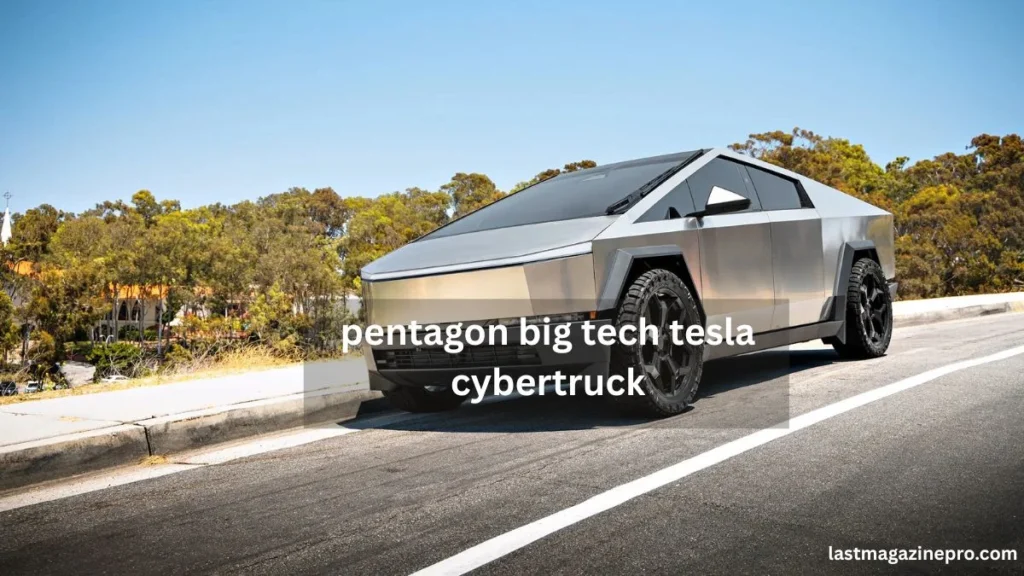
The Cybertruck is Tesla’s angular, stainless-steel electric pickup, built with an exposed 30X cold-rolled stainless-steel exoskeleton instead of a traditional painted body panel structure. This unpainted, ultra-hard steel shell is central to almost every defense-adjacent conversation about the vehicle.
2. Performance and Specifications
The Cybertruck runs on Tesla’s 48-volt electrical architecture, a departure from the 12-volt systems used in most vehicles, which Tesla says improves efficiency and reduces wiring complexity. Depending on trim, the truck offers dual- or tri-motor configurations, adaptive air suspension, and a claimed towing capacity built around its steel-reinforced frame.
3. Safety Features
Tesla has marketed the Cybertruck’s windows and side panels as resistant to certain small-arms rounds under specific test conditions. It’s important to be precise here: this is “bulletproof” in a narrow, marketing sense resistance to specific calibers at specific ranges not the layered ballistic protection engineered into purpose-built armored military vehicles.
4. Autonomous Driving Technology
Like other Tesla vehicles, the Cybertruck supports Tesla’s driver-assistance suite, built on the company’s camera-based computer vision stack. It is a driver-assistance system, not a fully autonomous platform, and it was not designed or certified for unsupervised military operation.
5. Military Potential
The Cybertruck was never designed as a combat vehicle. It lacks armor plating, blast protection, run-flat combat tires, and hardened electronics the baseline requirements for any vehicle intended for battlefield use. Its relevance to the military so far has been narrower and more specific, discussed below.
Why Are the Pentagon, Big Tech, and Tesla Connected?
1. AI and National Security
The connective thread across all three is artificial intelligence. The Pentagon views AI for intelligence analysis, logistics, cyber defense, and autonomous systems as a decisive advantage, and that AI overwhelmingly comes from commercial developers rather than in-house military labs.
2. Defense Contracts
Beyond cloud and AI, several tech-adjacent companies hold direct defense contracts: Palantir provides data-analytics and AI targeting platforms to the DoD Anduril, founded by Palmer Luckey, builds autonomous defense systems and SpaceX founded by Elon Musk, who also leads Tesla holds multibillion-dollar launch and satellite-communications contracts with the Pentagon.
3. Autonomous Transportation
Military planners are watching commercial advances in autonomous and electric vehicles closely, not necessarily to adopt them outright, but to understand how such technology might appear on future battlefields, in the hands of both allies and adversaries.
4. Government Technology Partnerships
Programs like the Defense Innovation Unit and the JWCC cloud contract formalize a pattern where the Pentagon partners directly with commercial technology firms rather than commissioning bespoke systems from traditional defense contractors alone.
Can the Tesla Cybertruck Be Used by the Military?
1. Potential Military Applications
In theory, any rugged, high-payload electric vehicle could support logistics, base transport, or reconnaissance roles. In practice, the Cybertruck has not been adopted for any of these roles by the U.S. military as of 2026.
2. Tactical Transportation
The Cybertruck’s steel body and torque-heavy electric drivetrain are sometimes cited as useful traits for off-road or logistics tasks, but the vehicle lacks the hardened communications, blast protection, and field-serviceability that tactical military vehicles require.
3. Border Security
Some discussion has floated the Cybertruck as a candidate for border-patrol or domestic security fleets given its durability claims, but no confirmed federal procurement of Cybertrucks for that purpose has been finalized.
4. Emergency Response
The truck’s power-export capability (its ability to run tools or charge equipment off the vehicle battery) has drawn interest for disaster-response and emergency-power scenarios, a civilian-adjacent use case more plausible in the near term than a combat role.
5. Current Limitations
The clearest, most concrete Pentagon-Cybertruck connection to date is the opposite of adoption: in 2025, the U.S. Air Force Test Center requested two Tesla Cybertrucks by name as part of an order for 33 target vehicles destined for the Standoff Precision Guided Munitions (SOPGM) program at White Sands Missile Range in New Mexico. The justification documents specifically cited the Cybertruck’s stainless-steel exoskeleton and 48-volt electrical architecture as distinct from typical painted-steel target vehicles, and noted the vehicles were wanted to help ensure munitions remain effective against a Cybertruck-style body if adversaries were to use similar vehicles. In short: the Air Force’s interest in Cybertrucks so far has been to blow them up for testing, not to drive them into battle.
How Big Tech Supports Pentagon Projects?
1. Artificial Intelligence
Big Tech firms supply large language models, computer-vision systems, and predictive-analytics tools that the Pentagon uses for intelligence processing, logistics forecasting, and decision support.
2. Cloud Infrastructure
The JWCC contract awarded to Microsoft, AWS, Google, and Oracle underpins much of the department’s move toward scalable, secure cloud computing across both classified and unclassified environments.
3. Cyber Defense
Commercial cybersecurity platforms help the Pentagon monitor and defend its networks against increasingly sophisticated state-sponsored threats, often incorporating the same threat-intelligence tools used to protect private-sector infrastructure.
4. Robotics and Automation
Companies like Anduril and various robotics-focused Big Tech partners are developing autonomous drones, ground robots, and sensor networks intended to reduce risk to personnel in dangerous environments.
5. Data Analytics
Palantir’s data-integration platforms remain among the most visible examples of a commercial tech company embedded directly in Pentagon intelligence and targeting workflows.
Cybersecurity Implications
1. Vehicle Security
Any connected vehicle Cybertruck included carries a larger digital attack surface than older, non-networked vehicles. Over-the-air software, telematics, and onboard connectivity all represent potential intrusion points that would need to be hardened before any military use.
2. Military Encryption
Defense-grade communications require encryption standards far beyond what consumer vehicles or consumer cloud products ship with by default, which is why commercial technology adopted by the Pentagon typically undergoes significant security modification first.
3. AI Security
As AI tools move into national-security workflows, protecting those models from data poisoning, adversarial manipulation, and unauthorized access has become its own specialized field within Pentagon cybersecurity planning.
4. Defense Networks
Big Tech’s cloud contracts include specific provisions for operating within classified network environments, a requirement that goes well beyond standard commercial cloud security practices.
5. Supply Chain Protection
Both AI hardware (chips, servers) and vehicle components increasingly draw scrutiny over supply-chain origin, given concerns about foreign-made components in systems that touch national security infrastructure.
AI and Autonomous Vehicles
1. Military AI Systems
The Pentagon’s AI investments span everything from predictive maintenance on aircraft to battlefield sensor fusion, most of it built on commercially developed AI infrastructure rather than bespoke military-only systems.
2. Autonomous Driving
Commercial autonomous-driving research including Tesla’s is studied by military technologists less as a product to adopt directly and more as a preview of what capabilities (and vulnerabilities) will eventually reach the battlefield.
3. Computer Vision
Camera-based perception systems, the same underlying technology in Tesla’s driver-assistance suite, have direct analogues in military surveillance, targeting, and autonomous-navigation research.
4. Drone Technology
Commercial drone advances cheap, mass-producible, and increasingly autonomous have already reshaped modern conflict, making drone technology one of the clearest examples of civilian innovation crossing directly into military use.
5. Human-Machine Teaming
A growing area of Pentagon research focuses on how human operators work alongside semi-autonomous systems, a field that draws heavily on commercial AI and robotics research.
The Future of Defense Mobility
1. Electric Military Vehicles
The military has explored electrification for select non-combat roles base vehicles, generators, and some support fleets largely for fuel-logistics and noise-reduction benefits, though full electrification of combat vehicles remains distant given power, range, and battlefield-charging constraints.
2. Battery Innovation
Advances in battery energy density and charging speed, largely driven by the commercial EV industry, could eventually filter into military logistics and support vehicles.
3. Smart Logistics
AI-driven logistics platforms tracking fuel, parts, and supply chains in real time represent one of the more mature and lower-controversy applications of Big Tech AI within the Pentagon today.
4. Sustainable Defense Transportation
Energy resilience, not environmental branding, is the Pentagon’s primary interest in alternative-fuel and electric vehicles: reducing fuel convoys reduces the exposure of troops to attack.
Challenges and Concerns
1. Privacy Issues
Consumer-grade connected vehicles and AI platforms collect substantial data by design, raising questions about what happens when that data infrastructure intersects with government or defense use.
2. Ethical Considerations
The growing role of AI in military decision-making, including any function that touches targeting or lethal force, raises ongoing ethical and oversight questions that both the Pentagon and its tech partners continue to navigate publicly.
3. Government Regulations
Procurement law, export controls, and conflict-of-interest rules all apply differently to Big Tech vendors than to traditional defense contractors, and regulators continue to adapt existing frameworks to fit this newer category of supplier.
4. Procurement Costs
Large cloud and AI contracts like JWCC run into the billions of dollars, and cost overruns or scope changes on programs this size draw regular scrutiny from Congress and government watchdogs.
5. Battery Limitations
Cold-weather performance, charging infrastructure in remote or contested areas, and vulnerability of battery packs to damage remain real obstacles to any serious military EV adoption.
6. Cyber Threats
Every additional connected system vehicle, cloud platform, or AI model expands the Pentagon’s potential attack surface, making cybersecurity a constant constraint on how quickly new commercial technology can be integrated.
Frequently Asked Questions
Q1: Is the Pentagon Using Tesla Cybertruck?
No, not as an operational military vehicle. The clearest documented Pentagon interest in the Cybertruck was a 2025 Air Force Test Center order for two units to serve as missile-test targets at White Sands Missile Range, not for combat or transport use.
Q2: Does Tesla Have Pentagon Contracts?
Tesla itself does not hold major Pentagon defense contracts for the Cybertruck. However, Elon Musk’s other company, SpaceX, holds substantial Department of Defense contracts for launch services and satellite communications.
Q3: Why Does Big Tech Work With the Pentagon?
Big Tech works with the Pentagon because the department needs commercial-grade AI, cloud computing, and cybersecurity capabilities that it cannot build as quickly or cost-effectively in-house, while tech companies gain large, stable government contracts.
Q4: Can Cybertruck Become a Military Vehicle?
It’s technically possible for a derivative or heavily modified version to serve a support role someday, but as designed, the Cybertruck lacks the armor, hardened electronics, and battlefield durability required for combat use.
Q5: Is Tesla Involved in Defense Technology?
Tesla itself is primarily a commercial automaker and energy company, but it sits inside a broader Musk-led technology ecosystem alongside SpaceX and xAI that is increasingly intertwined with U.S. defense and government technology priorities.
Q6: How Does AI Connect Big Tech and the Pentagon?
AI is the primary link the Pentagon relies on commercially developed AI models and cloud infrastructure from companies like Microsoft, Google, Amazon, and Palantir to power everything from logistics forecasting to intelligence analysis.
Conclusion
The phrase “Pentagon, Big Tech, and Tesla Cybertruck” sounds like it describes one unified partnership, but it actually captures three separate if overlapping stories. The Pentagon’s relationship with Big Tech is real, substantial, and centered on AI and cloud infrastructure worth billions of dollars. Tesla’s broader connection to defense runs mostly through Musk’s other ventures, particularly SpaceX. And the Cybertruck itself, despite its futuristic design, has entered military conversation chiefly as a test target rather than a combat platform. Understanding these distinctions matters it separates a genuine, fast-moving shift in how the U.S. military sources technology from the more speculative headlines about Cybertrucks on the battlefield.
Read More Related Articles:
- MyFastBroker Com: Features, Benefits, Services & Complete Guide
- Woeken: The Complete Guide to Its Meaning, Origins, Uses, and Why It’s Spreading Online
- Euroyungs com Explained | Is It Safe, Legit, and What Should You Know Before Visiting?
- Faibloh | What Is It, and Why Does the Internet Disagree About It?
- Trendywinner com | Complete Guide to Features, Content & User Experience
- REPMOLD | Meaning, Uses, Features, Applications & Complete Guide
- TxMyZone | Complete Guide, Features, Benefits, and How It Works
- Milyom | Meaning, Uses, Features, and Everything You Need to Know

My name is Arman, and I am the founder of Last Magazine Pro, a digital publication dedicated to delivering high-quality content on business, technology, artificial intelligence, startups, investing, and leadership. I am passionate about creating informative, well-researched, and reader-focused content that helps people stay informed about the latest trends and innovations. My goal is to build a trusted platform that provides valuable insights, practical knowledge, and reliable information for professionals, entrepreneurs, and curious readers around the world.