AI Transformation Is a Problem of Governance: Why Leadership Matters More Than Technology
Source:https://lastmagazinepro.com/
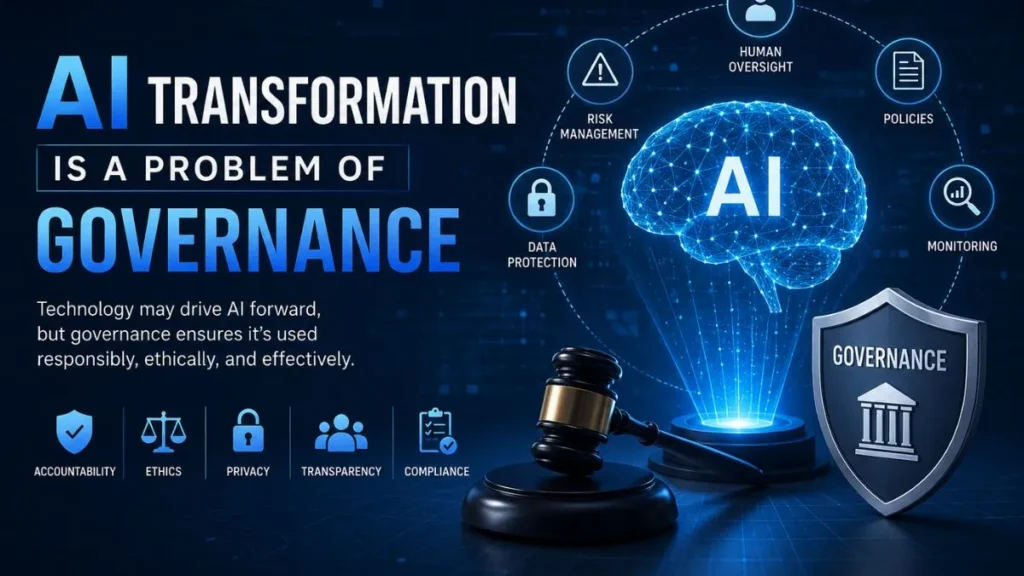
AI transformation is a problem of governance, not simply a technology challenge. As organizations rapidly adopt artificial intelligence, they must also address critical issues such as accountability, data privacy, security, transparency, bias, and regulatory compliance. Successful AI transformation requires clear policies, responsible decision-making, and effective human oversight. Without strong governance, even advanced AI systems can create significant operational, ethical, and reputational risks. This is why organizations need to treat AI governance as a core part of their transformation strategy rather than an afterthought.
What Does “AI Transformation Is a Problem of Governance” Mean?
- AI transformation refers to the organizational shift toward embedding artificial intelligence into core operations — decision-making, customer service, product development, and internal workflows — rather than using it as an isolated experiment.
- AI governance is the structure that determines how that shift happens safely. It’s the set of rules, roles, and checkpoints that decide who can deploy a model, what it’s allowed to do, and how its outputs get checked.
As AI adoption increases, governance stops being optional. A single chatbot answering FAQs carries low risk. The same technology approving loan applications or making hiring recommendations carries legal, ethical, and financial exposure that no engineering team can manage alone.
This is the line between AI implementation and responsible AI transformation. Implementation is deploying a tool. Transformation is redesigning how a business operates around that tool — with the guardrails to match.
- Quick Answer
What is AI governance? AI governance is the framework of policies, responsibilities, controls, and oversight used to ensure AI systems are developed and used safely, ethically, transparently, and in alignment with organizational goals.
Why AI Transformation Is Primarily a Governance Challenge
1. Accountability and Decision-Making
When an AI system makes a harmful decision — a wrongful denial, a biased recommendation, a costly error — who answers for it? Without clear ownership, responsibility gets diffused across data science, IT, legal, and business units until no one actually owns the outcome. Effective governance assigns ownership before deployment, not after an incident.
2. Data Privacy and Security
AI systems are only as trustworthy as the data feeding them. That raises hard questions: What personal or proprietary data can a model access? Who audits that access? Governance frameworks set the boundaries — data classification, retention limits, and compliance checks — that keep AI systems from becoming a privacy liability.
3. AI Bias and Fairness
Models trained on biased historical data reproduce and often amplify that bias at scale. A hiring algorithm trained on decades of skewed hiring data won’t correct the pattern — it will encode it. Governance requires ongoing bias testing and monitoring, not a one-time fairness check before launch.
4. Transparency and Explainability
If a business can’t explain why an AI system made a particular decision, it can’t defend that decision to a regulator, a customer, or a court. Explainability isn’t a nice-to-have; it’s what allows an organization to build trust with the people affected by its AI systems.
5. Regulatory and Compliance Risks
AI regulation is moving fast and unevenly across regions and industries. Organizations that build rigid, static policies get caught flat-footed. Governance needs to be a living process — one that adapts as new rules take effect, rather than a document written once and filed away.
The Core Pillars of AI Governance
- Accountability — clear ownership for AI outcomes
- Transparency — decisions that can be explained and audited
- Privacy and Data Protection — controlled, compliant data use
- Security — protection against misuse, manipulation, and breach
- Fairness and Bias Management — ongoing testing for equitable outcomes
- Human Oversight — a person in the loop for consequential decisions
- Risk Management — proactive identification of what could go wrong
- Continuous Monitoring — tracking model behavior after deployment, not just before
How Poor Governance Can Derail AI Transformation
Weak governance doesn’t just create risk in theory — it actively derails transformation efforts:
- Uncontrolled AI adoption, where teams deploy tools independently with no oversight or shared standards
- Security vulnerabilities, as ungoverned systems become easy targets for manipulation or data leakage
- Compliance failures, triggering fines and legal exposure
- Biased or unreliable outputs, damaging both decisions and reputation
- Loss of customer trust, once one visible failure becomes public
- Financial and reputational damage that can outweigh any efficiency the AI system provided
- Difficulty scaling AI across the organization, because each new use case has to solve the same governance problems from scratch
AI Governance vs. Traditional IT Governance
| Dimension | Traditional IT Governance | AI Governance |
|---|---|---|
| Decision-making | Rule-based, deterministic systems | Probabilistic outputs that can shift over time |
| Data management | Structured, well-defined data flows | Constant ingestion of dynamic, often unstructured data |
| Risk | Primarily uptime, security, and cost | Adds bias, fairness, explainability, and ethical risk |
| Accountability | Clear system owners and change logs | Shared accountability across data, legal, and business teams |
| Model monitoring | Periodic system audits | Continuous performance and drift monitoring |
| Human oversight | Oversight at build and deployment stages | Oversight required throughout the model’s operating life |
| Regulatory requirements | Established, relatively stable standards | Rapidly evolving, often jurisdiction-specific rules |
The core difference: traditional IT systems behave predictably once built. AI systems can drift, degrade, or behave unexpectedly on new data — which means governance can’t be a one-time gate. It has to be ongoing.
How Organizations Can Build an Effective AI Governance Framework
1. Identify AI Use Cases Catalog every current and planned use of AI across the organization — including tools individual teams have adopted informally.
2. Classify AI Risks Not every use case carries equal risk. Rank use cases by potential impact — financial, legal, reputational, and human — to prioritize oversight where it matters most.
3. Define Roles and Responsibilities Assign clear ownership for each stage: development, deployment, monitoring, and incident response.
4. Establish AI Policies Set written standards for acceptable use, data handling, model testing, and escalation paths.
5. Create Human Oversight Mechanisms Build in review points where a person can intervene before a high-stakes AI decision takes effect.
6. Test AI Systems Before Deployment Validate accuracy, fairness, and robustness against edge cases — not just average-case performance.
7. Monitor Models Continuously Track drift, unexpected outputs, and changing data patterns after launch, since a model’s real-world behavior can shift over time.
8. Review and Update Governance Policies Revisit policies on a set cadence, and whenever regulations, use cases, or risk levels change.
The Role of Leadership in AI Governance
Governance fails when it’s treated as a technical team’s problem. Executives need to own AI strategy directly — not just fund it — because the trade-offs involved (speed vs. safety, innovation vs. risk) are business decisions, not engineering ones.
Effective organizations build cross-functional AI governance teams that bring legal, security, data science, and business leadership to the same table. They align AI investments with actual business objectives instead of chasing AI adoption for its own sake. And they build a culture where flagging a risk is rewarded, not treated as an obstacle to shipping faster.
AI Governance and the Future of Digital Transformation
AI is no longer a bolt-on feature — it’s becoming embedded across core business operations, from customer support to financial forecasting to product design. As that embedding deepens, governance becomes more important, not less: the more decisions AI touches, the higher the cost of getting oversight wrong.
The organizations succeeding at scale are moving from experimentation to responsible deployment — treating governance as infrastructure designed in from day one, not a compliance checkbox added after a system is already live.
Common AI Governance Mistakes to Avoid
- Treating governance as an afterthought, added only after a problem surfaces
- Focusing only on technical performance, while ignoring fairness, transparency, and accountability
- Ignoring employees and stakeholders who will actually use or be affected by the system
- Using unclear accountability structures, where no one is really responsible for outcomes
- Failing to monitor AI after deployment, assuming a model that worked at launch will keep working
- Creating policies without practical enforcement, so governance exists on paper but not in practice
Frequently Asked Questions
- Is AI transformation mainly a technology problem? No. Technology is one component of AI transformation, but success depends far more on how an organization controls, monitors, and takes responsibility for what that technology does. Governance determines whether AI adoption is sustainable or a liability waiting to surface.
- Why is governance important in AI transformation? Governance manages the risk, accountability, and compliance exposure that come with deploying AI, while building the trust needed for responsible, lasting adoption.
- What are the main challenges of AI governance? The core challenges span privacy, security, bias, transparency, accountability, regulatory compliance, and continuous monitoring — each requiring ongoing attention rather than a one-time solution.
- Who should be responsible for AI governance? Responsibility is shared. Leadership sets strategy and accountability, legal and compliance teams manage regulatory risk, IT and security teams protect systems and data, data teams manage model quality, and business stakeholders ensure AI aligns with real operational needs.
- How can companies improve AI governance? Start by cataloging all AI use cases, classify them by risk, assign clear ownership, write enforceable policies, build in human oversight for high-stakes decisions, and monitor deployed systems continuously rather than only at launch.
Key Takeaways
- AI transformation requires more than advanced technology — it requires organizational readiness.
- Governance establishes accountability and control before problems occur, not after.
- Responsible AI needs continuous monitoring, not a one-time approval process.
- Strong governance is what allows organizations to scale AI safely across the business.
- The best AI strategies combine innovation with oversight — neither works well without the other.
Conclusion
The organizations winning at AI aren’t necessarily using more advanced models than their competitors. They’re the ones who built the accountability structures, policies, and oversight mechanisms to deploy AI without it deploying risk right alongside it.
AI transformation is a problem of governance as much as it is a problem of technology. Organizations that establish clear accountability, responsible policies, human oversight, and continuous monitoring will be the ones positioned for AI transformation that actually lasts — not just a pilot program that looked good in a slide deck.
Read More Informative Articles Please Visit This Site:https://lastmagazinepro.com/

Sobia is an SEO Expert and Content Writer specializing in keyword research, SEO optimization, and engaging content that improves search rankings, drives organic traffic, and enhances online visibility.