Geometry Learning V3 | Features, Uses, and What Learners Should Know
Source: lastmagazinepro.com
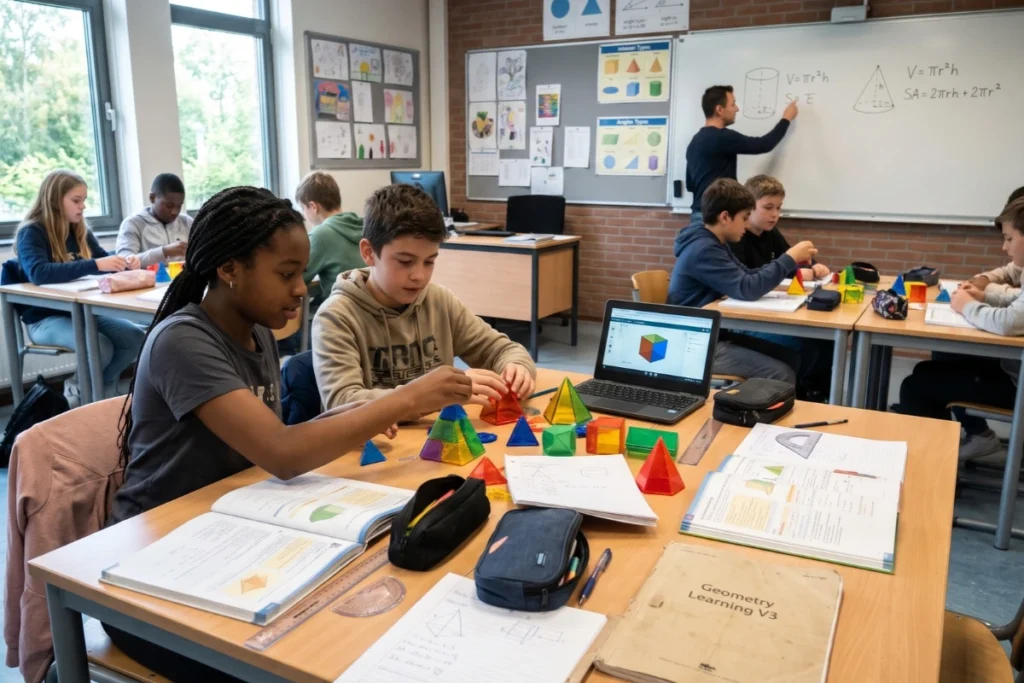
Learning geometry becomes easier when mathematical ideas are connected to clear explanations, diagrams, and practical examples. From recognizing shapes to understanding angles and calculating areas, geometry helps students develop logical thinking and solve problems in school and everyday life. This has made digital learning resources an increasingly interesting option for learners who want to explore mathematics in different ways.
Geometry Learning V3 is a search term associated with an online project that appears under the name “V3 – The GL Series.” Its publicly visible interface includes sections such as Games, Apps, Extras, and a beta search feature. However, the information available online does not consistently establish it as a complete geometry course.
Understanding this distinction is important before using the resource for schoolwork or recommending it to someone else. This guide explores what Geometry Learning V3 appears to be, how to evaluate its features, which geometry concepts learners should understand, and what to consider when choosing an online learning resource.
What Is Geometry Learning V3?
Geometry Learning V3 is a keyword associated with an independent browser-based project identified online as part of the GL Series. The publicly accessible project displays V3 branding and provides navigation to Games, Apps, and Extras, alongside a beta search interface.
The name can create the impression of a dedicated mathematics course, but a name alone cannot confirm the purpose or educational quality of a website. Some third-party articles describe Geometry Learning V3 as a resource related to interactive geometry, while other descriptions focus on its broader browser-based environment.
For this reason, readers should distinguish between the project’s observable features and claims made about it elsewhere.
A reliable evaluation should answer several questions:
-
Does the website actually provide geometry lessons or mainly offer games and other web resources?
-
Are mathematical explanations and worked examples available?
-
Can users practise questions and check their answers?
-
Is there a clear description of the developer and the project’s purpose?
-
Does the resource support a learner’s specific educational goals?
These questions help determine whether the website is useful for mathematics practice, general browsing, entertainment, or another purpose.
What Does V3 Mean?
The term “V3” commonly functions as a software version label, and it appears in the project’s public branding. However, the available information does not establish a complete development history or explain exactly which changes distinguish this version from earlier releases.
It would therefore be misleading to assume that V3 automatically means a more advanced geometry curriculum, improved teaching methods, or a third-generation educational platform.
The most reasonable approach is to treat V3 as the displayed version designation until the project’s owner provides more detailed documentation.
How Does Geometry Learning V3 Work?
The publicly described interface includes general website sections rather than a clearly documented sequence of geometry lessons. The actual activities and available functions should be checked directly before drawing conclusions about the platform.
A sensible way to explore the resource is to follow these steps:
-
Check the original website. Confirm the domain and make sure you are viewing the intended project.
-
Explore its available sections. Review Games, Apps, and Extras to understand what is actually offered.
-
Look for relevant educational activities. Determine whether an activity explains mathematical concepts or simply provides entertainment.
-
Test the learning value. If a geometry activity is available, check whether it helps you understand a concept and apply it to a new problem.
-
Evaluate its limitations. Look for missing explanations, unclear instructions, or features that require additional learning materials.
This approach prevents users from assuming that every feature described in a third-party article exists on the live website.
Essential Geometry Concepts Every Learner Should Know
Whether you are using Geometry Learning V3 or another educational resource, understanding the fundamentals of geometry provides a strong foundation for more advanced mathematics.
1. Points, Lines, Rays, and Line Segments
Geometry begins with position and direction. A point identifies a location, a line extends infinitely in both directions, a ray begins at one point and continues in one direction, and a line segment has two endpoints.
For example, the straight edge of a ruler can help illustrate a line segment. Learning to distinguish these objects makes it easier to understand angles, polygons, and geometric diagrams.
2. Angles and Their Types
An angle forms when two rays share a common endpoint. Angles are commonly measured in degrees.
| Angle type | Measurement |
|---|---|
| Acute angle | Less than 90° |
| Right angle | Exactly 90° |
| Obtuse angle | Greater than 90° and less than 180° |
| Straight angle | Exactly 180° |
| Reflex angle | Greater than 180° and less than 360° |
Recognizing these categories helps students solve geometry problems and understand shapes in buildings, road layouts, drawings, and everyday objects.
3. Triangles and Polygons
A triangle has three sides and three interior angles. The interior angles of a triangle add up to 180° in ordinary Euclidean geometry.
For instance, if two angles measure 60° and 70°, the third angle is:
Polygons extend this idea to shapes with more straight sides, including squares, rectangles, pentagons, and hexagons. Understanding their properties helps learners recognize patterns and solve measurement problems.
4. Circles and Their Measurements
A circle is defined by points that are equally distant from a fixed center. Its radius measures the distance from the center to the circumference, while its diameter passes through the center and connects two points on the circle.
Two important formulas are:
Here, \(d\) represents diameter, \(r\) represents radius, and \(A\) represents area.
These formulas are useful when measuring circular objects such as wheels, plates, and garden features.
5. Perimeter, Area, and Volume
These three concepts describe different measurements.
-
Perimeter measures the total distance around a two-dimensional shape.
-
Area measures the surface enclosed by a two-dimensional boundary.
-
Volume measures the space occupied by a three-dimensional object.
For a rectangle with a length of 8 cm and a width of 5 cm:
The example illustrates why learners must understand the difference between distance and surface area rather than simply memorizing formulas.
6. Symmetry and Coordinate Geometry
Symmetry describes how parts of a shape correspond when reflected, rotated, or arranged around a point or axis. Coordinate geometry uses numerical coordinates to describe positions and relationships on a plane.
These concepts become particularly useful when studying graphs, maps, design, engineering, and more advanced mathematics.
Potential Benefits of Interactive Geometry Learning
Digital resources can make mathematical ideas more accessible when they combine visual explanations with meaningful practice. However, these general educational benefits should not be interpreted as proven outcomes of Geometry Learning V3 specifically.
1. Visualizing Abstract Ideas
A written formula can sometimes feel disconnected from the problem it represents. A diagram can make the same relationship easier to interpret.
The US Institute of Education Sciences’ What Works Clearinghouse identifies teaching students to use visual representations as a strategy supported by strong evidence for improving mathematical problem-solving in Grades 4–8. Its guidance explains how diagrams and other representations help students organize information and recognize relationships.
This is a useful evidence-based reason to seek out geometry resources with clear diagrams and meaningful visual explanations.
2. Developing Problem-Solving Skills
Geometry requires learners to identify relevant information, recognize patterns, select formulas, and explain their reasoning. Regular practice can help students become more systematic in approaching unfamiliar problems.
Instead of memorizing a formula without context, try to understand why it works and when it applies.
3. Learning Through Practice and Feedback
Practice is most valuable when learners can identify mistakes and understand how to correct them. The Education Endowment Foundation identifies feedback as an evidence-supported teaching approach, emphasizing specific guidance that helps learners improve.
When evaluating a digital geometry tool, check whether it provides useful explanations or merely marks an answer as correct or incorrect.
4. Connecting Mathematics With Everyday Life
Geometry appears in architecture, interior design, construction, computer graphics, maps, and product design. Practical examples help learners see how classroom concepts relate to real situations.
For example, calculating the area of a rectangular room helps estimate flooring requirements, while understanding angles can help when measuring slopes or planning layouts.
What Do Statistics and Educational Research Tell Us?
A trustworthy article should distinguish established research findings from unsupported statistics about a particular website.
The following evidence provides context for evaluating geometry-learning methods.
1. Grades 4–8
The What Works Clearinghouse practice guide on mathematical problem-solving addresses learners in Grades 4–8 and rates instruction in visual representations as a strategy supported by strong evidence.
2. Over 3,000 studies
The Education Endowment Foundation describes its mathematics evidence review for Key Stages 2 and 3 as examining findings from over 3,000 studies of teaching approaches for pupils aged 9–14. This is the scope of the review, not the number of studies proving that one particular digital tool works.
No verified platform-specific result
The sources reviewed for this article do not establish a reliable percentage improvement in test scores, a user-success rate, or a measured learning outcome specifically attributable to Geometry Learning V3.
The practical takeaway is straightforward: evidence supports using well-chosen visual representations and effective feedback in mathematics instruction, but it does not prove that every website featuring games or interactive elements will improve learning.
Who May Find Geometry Learning V3 Useful?
The usefulness of Geometry Learning V3 depends on what the person visiting the website wants to accomplish and which activities are actually available.
- Students may explore the project to discover browser-based activities, but they should confirm whether those activities support their current school subjects.
- Parents should check the content, privacy practices, advertisements, and external links before recommending an unfamiliar website to children.
- Teachers can evaluate whether a particular activity reinforces a lesson objective or provides a useful supplementary exercise.
- Independent learners should identify their learning goals first. Someone studying triangle properties needs different resources from someone looking for general browser games.
The key is to evaluate the actual content rather than assume that the website’s name guarantees a specific educational experience.
Is Geometry Learning V3 Safe to Use?
An unfamiliar website should be evaluated carefully, especially when children or school devices are involved.
The available descriptions identify the project as a browser-based website, but that alone is not sufficient to establish its security, privacy practices, or suitability for every user.
Before using it, consider these precautions:
-
Verify the website address and check that it matches the intended project.
-
Look for privacy information and details about the website’s operator.
-
Avoid downloading unfamiliar files or installing unexpected browser extensions.
-
Do not enter passwords, payment details, or personal information unless there is a clear, legitimate reason.
-
Leave the site if your browser displays a security warning or suspicious pop-ups.
-
For children, review the available activities and follow applicable school or family internet policies.
These are general online safety practices, not a claim that the website has been found unsafe.
Geometry Learning V3 vs. Established Educational Resources
If your main goal is to learn mathematics, it is worth comparing the project with resources that clearly identify their educational content.
1. GeoGebra
GeoGebra is worth exploring if you want to investigate geometric constructions, manipulate mathematical objects, and examine relationships visually. Check the specific tool or activity that matches your level.
2. Khan Academy
Khan Academy is an option for learners seeking organized mathematics lessons and practice. Check its available geometry content against your curriculum and learning level.
The important difference is not that one resource must be better for everyone. It is that clearly documented lessons, worked examples, and practice opportunities make it easier to determine whether a resource supports a specific learning goal.
How to Get Better at Geometry: A Practical Learning Plan
You can use the following seven-day plan with a textbook, a structured educational website, or suitable geometry activities. It is a suggested routine, not a guaranteed-results program.
| Day | Topic | Practice goal |
|---|---|---|
| 1 | Points, lines, and angles | Identify and classify basic geometric objects. |
| 2 | Triangles | Solve problems involving interior angles. |
| 3 | Polygons | Compare shapes and their properties. |
| 4 | Circles | Practise radius, diameter, and area. |
| 5 | Perimeter and area | Solve real-world measurement problems. |
| 6 | Symmetry and coordinates | Draw shapes and identify transformations. |
| 7 | Review | Solve mixed questions and revisit mistakes. |
A short, focused session can include three activities: review a concept, solve several questions, and explain the reasoning behind your answers. Adjust the difficulty to your current level.
For additional support, use worked examples and visual diagrams. When you make a mistake, identify whether it came from misunderstanding the concept, choosing the wrong formula, or making a calculation error.
Frequently Asked Questions About Geometry Learning V3
Q1: What is Geometry Learning V3?
Geometry Learning V3 is a search term associated with a browser-based project identified as V3 – The GL Series. Its publicly visible interface includes Games, Apps, Extras, and beta search. Its status as a complete geometry course has not been established by the sources reviewed.
Q2: Is Geometry Learning V3 an official educational platform?
The available information does not establish it as an accredited educational platform or identify a recognized educational authority responsible for a formal geometry curriculum. Users should verify the project’s ownership and educational claims before relying on it for schoolwork.
Q3: Does Geometry Learning V3 teach geometry directly?
Its name suggests a connection with geometry, and third-party descriptions associate it with mathematical learning. However, the publicly described interface does not establish a complete sequence of geometry lessons. Check the actual activities before assuming that specific topics are taught.
Q4: What does V3 mean in Geometry Learning V3?
V3 appears to bte he project’s version label. Without reliable documentation of its development history, it is not possible to confirm exactly what changed between versions or whether the label indicates any particular educational improvement.
Q5: Is Geometry Learning V3 free to use?
The sources reviewed do not establish complete pricing information or confirm that every feature is free. Check the live website for any payment requirements, advertisements, or restrictions before using it.
Q6: Can students use Geometry Learning V3 for schoolwork?
Students may explore suitable activities if they are available, but they should confirm that the content matches their syllabus. For exams and formal study, use curriculum-aligned materials that provide accurate explanations, worked examples, and sufficient practice.
Q7: Is Geometry Learning V3 safe for children?
Its suitability cannot be confirmed from its name or basic interface alone. Parents should inspect the site, review privacy information, check external links, and supervise children’s use where appropriate.
Q8: What are the alternatives to Geometry Learning V3?
GeoGebra is useful for exploring interactive mathematical constructions, while Khan Academy offers structured mathematics learning resources. The right choice depends on the learner’s age, existing knowledge, and educational goals.
Final Thoughts on Geometry Learning V3
Geometry Learning V3 is an interesting search term, but the most important consideration is understanding what the actual website provides. Its publicly described GL Series interface includes Games, Apps, Extras, and beta search, while third-party descriptions vary in how they characterize its educational purpose.
Rather than assuming that it is a complete geometry course, evaluate its available activities, check the reliability of its information, and compare its content with established learning resources.
For anyone studying geometry, the most effective starting point is a clear understanding of basic concepts, consistent problem-solving practice, and useful feedback. Digital tools can supplement that process when their content supports the learner’s goals.
Ultimately, choose a learning resource based on what it demonstrably teaches—not simply what its name promises.
Read More Informative Articles:
Multiplacationcom Guide | 7 Useful Facts and Learning Tips
MDNI Explained | 7 Important Facts You Need to Know
Unbannedg Guide 2026: What It Means, the Risks, and Safer Ways to Play
Urlwo Explained: What It Is, How It Works, and How to Use It Safely (2026 Guide)

My name is Arman, and I am the founder of Last Magazine Pro, a digital publication dedicated to delivering high-quality content on business, technology, artificial intelligence, startups, investing, and leadership. I am passionate about creating informative, well-researched, and reader-focused content that helps people stay informed about the latest trends and innovations. My goal is to build a trusted platform that provides valuable insights, practical knowledge, and reliable information for professionals, entrepreneurs, and curious readers around the world.