Irish Business Systems | Complete Guide for 2026
Source: ameliaclassics.co.uk
Running a business in Ireland today means juggling Revenue Online Service (ROS) compliance, GDPR obligations, and a workforce that expects modern digital tools all while competing with businesses that adopted the right systems years ago. The shift is measurable according to Central Statistics Office data, AI use among Irish enterprises more than doubled between 2023 and 2025, rising from 8% to 20%, while nearly three-quarters (73%) of Irish enterprises used paid cloud computing services in 2025. Adoption isn’t even, though large enterprises (58%) were significantly more likely to use AI than medium (29%) or small (17%) firms, which means smaller Irish businesses still have real ground to make up.
If you’ve searched for “Irish business systems,” you’re probably trying to answer one of two questions what software or technology infrastructure do Irish businesses actually use to run operations, or which specific provider should you trust with your point-of-sale, ERP, or accounting setup.
This guide covers both, drawing on official CSO enterprise surveys and firsthand implementation experience across Irish SMEs. We’ll walk through the categories of business systems Irish companies rely on, what the latest CSO data says about adoption by sector and company size, how to evaluate and choose between providers, and the compliance details ROS integration, GDPR data handling, Revenue reporting that are unique to operating in Ireland. Every recommendation here is grounded in published statistics and real-world deployment, not vendor marketing, so you can make a decision that fits your business rather than a generic template.
What Are “Business Systems” in an Irish Context?
“Business systems” is a broad term, and understanding which type applies to your search matters before you compare vendors.
The Two Common Meanings
- Business management software and IT infrastructure the ERP, point-of-sale (POS), accounting, HR, and CRM tools that Irish companies use to run day-to-day operations.
- A specific named provider most notably IBS (Irish Business Systems), a Cork-founded managed print and document services company established in 1972, which was acquired by Xerox in 2010 and continues to operate as IBS, a Xerox Company, supplying office technology across the island of Ireland.
Both are legitimate interpretations, and this guide addresses the operational/software side in depth, since that’s what most business owners are actually trying to solve when they land on this topic. Where relevant, we’ll flag when a term overlaps with a specific named vendor.
Why This Matters for Irish Businesses Specifically?
Ireland isn’t the UK, isn’t the US, and isn’t “generic EU.” Systems used here need to handle:
- Euro-denominated invoicing with correct Irish VAT rates (23% standard, 13.5% and 9% reduced rates, 0% for specific categories)
- ROS integration for VAT3 returns, RCT, and PAYE modernisation (PSR)
- GDPR and Irish Data Protection Commission (DPC) requirements for data hosting and processing
- Local banking rails (SEPA, Irish sort codes/IBANs)
- Bilingual capability where public-facing or public-sector-adjacent
A system built for a US or UK market and simply “localised” often gets these details wrong which is why so many Irish SMEs still end up combining a global platform (Xero, Sage, QuickBooks) with an Irish-specific bolt-on or bookkeeper.
The Core Categories of Irish Business Systems
1. Accounting and Financial Management Systems
This is the most universally adopted category, since Revenue compliance makes some form of digital bookkeeping close to mandatory in practice.
Common platforms used in Ireland:
- Xero (strong SME uptake, good accountant ecosystem)
- Sage Business Cloud Accounting
- QuickBooks Online
- Surf Accounts (Irish-built, VAT/RCT native)
- Big Red Cloud (Irish-built, ROS-integrated)
What to check before choosing
- Does it support Irish VAT rates and RCT deductions natively, or via a workaround?
- Can your accountant already work in this system? (Switching costs are often about people, not software.)
- Is bank feed integration available for AIB, Bank of Ireland, PTSB, and Revolut Business?
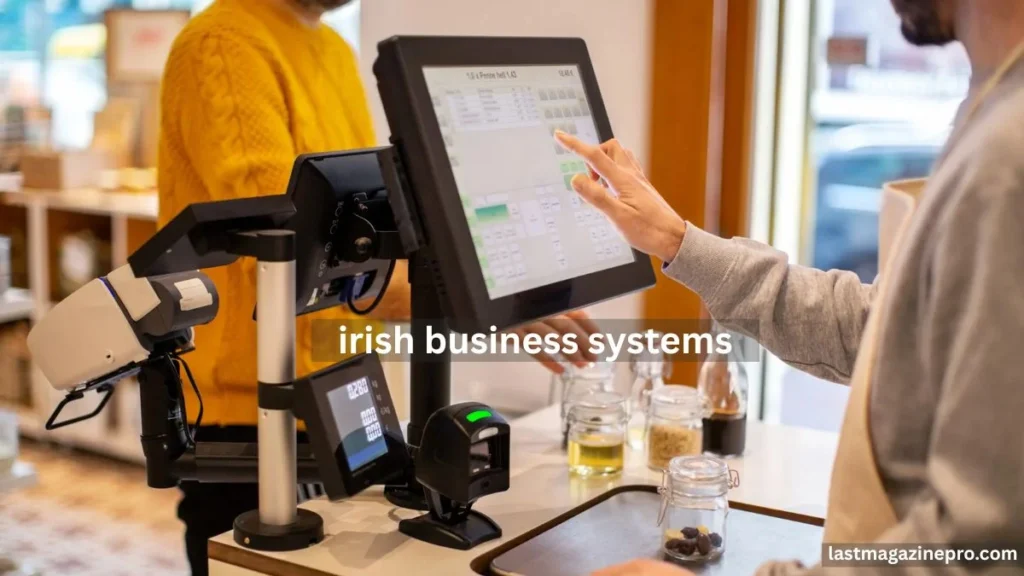
2. Point-of-Sale (POS) and Retail/Hospitality Systems
Retail, hospitality, and service businesses need POS systems that integrate stock control, staff management, and payment processing.
Providers active in the Irish market:
- ICRTouch (TouchPoint/TouchOffice) widely resold by Irish partners such as IBS Systems (NI)
- Lightspeed
- Square
- Epos Now
These systems typically handle kitchen printing, loyalty schemes, multi-site stock, and integrate with card payment providers like SumUp, Stripe, or AIB Merchant Services.
3. Enterprise Resource Planning (ERP)
ERP consolidates finance, inventory, procurement, and operations into a single system valuable once a business outgrows spreadsheets and disconnected tools.
Common ERP platforms in Ireland:
- Microsoft Dynamics 365 Business Central
- SAP Business One
- NetSuite
- Odoo (popular with cost-conscious SMEs and manufacturers)
According to CSO’s Information Society Statistics Enterprises 2025 release, ERP adoption across Irish enterprises overall is 34.7%, but nearly four in five large enterprises have adopted ERP compared with fewer than a third of small enterprises a gap that’s even more pronounced in manufacturing specifically.
4. Customer Relationship Management (CRM)
CRM adoption tends to follow sales team maturity rather than company size alone.
Common CRM tools: HubSpot, Salesforce, Zoho CRM, Pipedrive, Microsoft Dynamics CRM.
5. HR and Payroll Systems
Irish payroll has its own quirks (PAYE Modernisation, USC, PRSI classes), so generic global payroll tools often need an Irish-specific module or partner.
Common platforms: BrightPay, Sage Payroll, Big Red Book, Collsoft, Thesaurus Payroll Manager.
6. Cloud Infrastructure and IT Systems
Beyond software, “business systems” also covers the underlying IT cloud hosting, cybersecurity, and network infrastructure.
CSO data shows 73% of Irish enterprises used paid cloud computing services in 2025, the fourth-highest rate in the EU, with the sharpest increases in cloud usage for email, office software, and finance/accounting software each rising 10–12 percentage points since 2023.
Comparison Table: Business System Categories at a Glance
| System Type | Typical Users | Popular Providers (Irish Market) | Irish-Specific Must-Haves | Typical Monthly Cost (SME) |
|---|---|---|---|---|
| Accounting | All businesses | Xero, Sage, Surf Accounts, Big Red Cloud | ROS/VAT3, RCT support | €20–€70 |
| POS | Retail, hospitality | ICRTouch, Square, Lightspeed | VAT rate splitting, offline mode | €30–€100+ hardware |
| ERP | Manufacturing, distribution, scaling SMEs | Business Central, SAP B1, Odoo, NetSuite | Multi-currency, Irish tax localisation | €150–€1,000+ |
| CRM | Sales-led businesses | HubSpot, Pipedrive, Zoho | GDPR-compliant data storage | €0–€90 per user |
| Payroll | All employers | BrightPay, Thesaurus, Sage Payroll | PAYE Modernisation, PRSI classes | €30–€60 |
| Cloud/IT | All businesses | Microsoft 365, Google Workspace, AWS/local hosting | DPC-compliant hosting location | €5–€25 per user |
Note: Pricing is indicative and based on typical published SME tiers as of 2026; always confirm current pricing directly with vendors.
How to Choose the Right Business System for an Irish Company?
Step 1: Map Your Compliance Non-Negotiables First
Before comparing features, list what the system must do to keep you compliant VAT3 filing, RCT if you’re in construction, PAYE Modernisation for payroll, and GDPR-compliant data storage. Eliminate any platform that can’t meet these natively.
Step 2: Match the System to Your Actual Size, Not Your Ambition
The CSO data is a useful reality check here: most small Irish enterprises are not using ERP, and that’s often the right call. A full ERP rollout for a 12-person business frequently means paying for complexity you don’t need yet. A better sequence is usually:
- Solid cloud accounting
- A CRM once you have a dedicated sales function
- ERP only once you’re managing multi-location inventory, manufacturing, or complex procurement
Step 3: Check the Support Model
Ask directly: is support based in Ireland or the UK/EU time zone? Does the provider or reseller understand Irish tax law changes, or will you be the one explaining RCT to a support agent in another time zone?
Step 4: Pilot Before Committing
Run a 30–60 day trial with real transactions, not demo data. Irish VAT edge cases (mixed-rate invoices, reverse charge for EU B2B, RCT) tend to surface real gaps quickly.
Step 5: Plan for Integration, Not Just Adoption
The biggest hidden cost isn’t the software license it’s connecting your new system to your bank feeds, existing accountant workflows, and any e-commerce platform you run.
Cloud vs. On-Premise: Which Makes Sense in 2026?
For most Irish SMEs, cloud-based systems have become the default, and the CSO data backs this up: cloud computing adoption has grown fastest in exactly the areas businesses used to run on local servers email, office software, and finance/accounting.
When On-Premise Still Makes Sense
- Highly regulated data that a business wants to keep on local infrastructure for contractual reasons
- Manufacturing environments with legacy machine integrations that aren’t cloud-ready
- Businesses in areas where broadband reliability is still inconsistent (though this is shrinking fast under the National Broadband Plan)
When Cloud Wins
- Remote or hybrid teams
- Businesses needing real-time multi-site visibility
- Anyone prioritising automatic updates and lower upfront IT overhead
AI in Irish Business Systems: What’s Actually Happening?
AI adoption is one of the fastest-moving parts of this space. CSO figures show enterprise AI use more than doubled between 2023 and 2025, rising from roughly 8% to over 20% of Irish enterprises, with large enterprises (58%) far ahead of medium (29%) and small (17%) firms. The most common applications are data mining, followed by natural language generation and workflow automation.
Practically, this shows up inside business systems as:
- AI-assisted bank reconciliation in accounting software
- Predictive stock reordering in POS and ERP systems
- Automated lead scoring in CRM platforms
- AI-generated financial reporting summaries
If you’re evaluating new systems in 2026, ask vendors specifically what AI features are included versus sold as a paid add on pricing structures here vary widely between providers.
People Also Ask
What software do most small businesses in Ireland use?
Most Irish SMEs rely on a combination of cloud accounting software (commonly Xero, Sage, or an Irish-built platform like Big Red Cloud), a payroll tool with PAYE Modernisation support, and, for retail or hospitality, a POS system. Full ERP is far less common at small-business scale CSO data puts ERP adoption among small enterprises well below that of large enterprises.
Is Irish Business Systems the same as IBS Xerox?
Irish Business Systems (IBS) was an independent Cork-founded managed print and document services provider established in 1972. Xerox acquired the company in 2010, and it now operates as IBS, a Xerox Company, providing office and print technology across Ireland. If you’re specifically looking for this company rather than general business software, you’d want Xerox’s Irish channel or IBS directly.
What is the best accounting system for a small business in Ireland?
There isn’t a single universal “best” it depends on whether your accountant already works in a particular platform, whether you need RCT support (common in construction), and your budget. Xero and Sage have the widest accountant support networks; Irish-built tools like Surf Accounts and Big Red Cloud are built specifically around ROS and Irish VAT rules.
How much does a business management system cost in Ireland?
Costs range widely cloud accounting typically runs €20–€70 per month for a small business, POS systems often combine a monthly software fee (€30–€100) with hardware costs, and ERP implementations can run from a few hundred to several thousand euro per month depending on scale and customisation.
Do Irish businesses need GDPR-compliant systems?
Yes. Any system processing personal data customer records, employee data, payroll information must meet GDPR requirements, and Irish businesses fall under the oversight of the Data Protection Commission. This affects where data is hosted and how vendor contracts are structured, not just internal policy.
What’s the difference between ERP and accounting software?
Accounting software focuses on financial transactions invoicing, VAT, bank reconciliation. ERP is broader, integrating finance with inventory, procurement, manufacturing, and often HR into one connected system. Businesses typically start with accounting software and move to ERP once operational complexity (multi-location stock, manufacturing, complex procurement) outgrows what accounting software alone can manage.
Frequently Asked Questions
Q1: Can I run my Irish business entirely on free software?
A: Partially, Free tiers of tools like Wave or Zoho can cover very early-stage bookkeeping, but most growing Irish businesses need at least a paid accounting tool with VAT3/ROS support and a payroll tool once they hire staff.
Q2: How long does it typically take to switch business systems?
A: For accounting software, 4–8 weeks is realistic including data migration and a parallel run with your existing system. ERP implementations can take three to twelve months depending on complexity and customisation.
Q3: Do I need an Irish-based vendor, or can I use a UK/US platform?
A: You don’t strictly need an Irish-based vendor, but you do need Irish tax localisation (VAT rates, RCT, PAYE Modernisation) either built in or supported by a local implementation partner or accountant.
Q4: Are Irish-built systems better than international ones for compliance?
A: Irish-built tools (like Big Red Cloud or Surf Accounts) are often built VAT3/ROS-first, which can reduce configuration headaches. International platforms (Xero, Sage) have broader feature sets and larger accountant networks but may need extra setup to match every Irish-specific rule.
Q5: What’s the single biggest mistake businesses make when choosing a system?
A: Buying based on feature lists rather than actual current-size needs most commonly, small businesses adopting ERP-level complexity years before they need it, which slows adoption and wastes budget.
Conclusion
Choosing the right business system in Ireland isn’t about finding the platform with the longest feature list—it’s about matching the system to your actual size, your compliance obligations, and the realistic support you’ll get when something needs fixing at 4pm on a Friday before a VAT deadline. The CSO data makes one thing clear Irish businesses that scale their systems deliberately starting with solid accounting, adding CRM and POS as sales and operations demand it, and only reaching for ERP once complexity genuinely requires it tend to avoid the costly over-investment trap that catches so many growing companies. Whatever stage you’re at, the next right move is usually smaller and more immediate than “buy an ERP” get your VAT and payroll compliance airtight first, then build outward from there.
Please Visit This Site for Read More Informative Articles: Last Magazine Pro

My name is Arman, and I am the founder of Last Magazine Pro, a digital publication dedicated to delivering high-quality content on business, technology, artificial intelligence, startups, investing, and leadership. I am passionate about creating informative, well-researched, and reader-focused content that helps people stay informed about the latest trends and innovations. My goal is to build a trusted platform that provides valuable insights, practical knowledge, and reliable information for professionals, entrepreneurs, and curious readers around the world.




1 thought on “Irish Business Systems | Complete Guide for 2026”